Digital Campfire Methodology
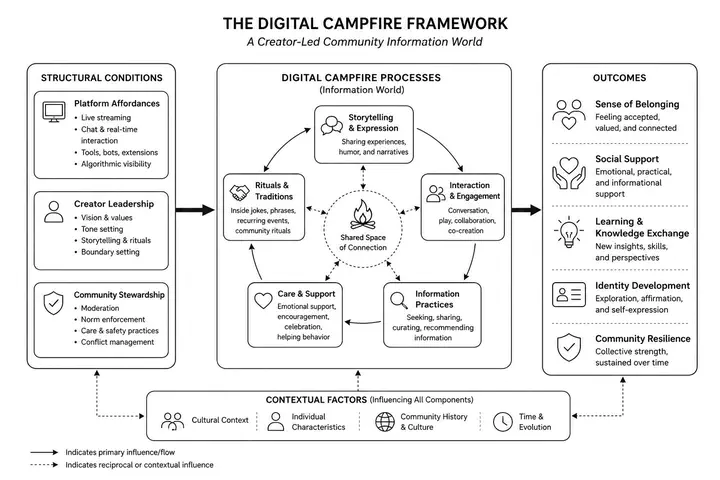
Digital campfires are the intentional gathering spaces people build around shared stories, rituals, play, and mutual support. They can appear in tabletop campaigns, online communities, games, Discord servers, livestream chats, learning cohorts, or other digital third places where people return because the space feels socially meaningful.
My digital campfire methodology is a way to discuss, design, and evaluate those spaces without reducing them to engagement metrics alone. It treats community as something that is tended: the conditions around the fire matter as much as the fire itself.
The Core Question
What makes a digital space feel safe enough for people to show up, participate, experiment with identity, and support one another over time?
This question sits between behavioral informatics, human-centered data science, therapeutic games, and community design. It asks how digital traces, social rituals, moderation patterns, and narrative structures can help us understand the health of a community while still respecting the people inside it.
Method Principles
Gather With Intention
A digital campfire starts with a reason to gather. The purpose does not need to be formal, clinical, or productivity-driven, but participants should understand why the space exists and what kind of participation it invites.
Build Rituals People Can Recognize
Strong communities develop repeatable moments: session openings, check-ins, recurring prompts, shared jokes, reflection rounds, celebrations, and ways to welcome newcomers. These rituals make the space easier to enter and easier to return to.
Design For Psychological Safety
Participation should not require performance, disclosure, or social risk beyond what the person chooses. Good campfire design creates room for listening, lurking, asking for help, opting out, and returning after absence.
Treat Data As A Community Signal
Digital trace data can show patterns of participation, connection, stress, and withdrawal, but those patterns should be interpreted with care. The goal is not surveillance. The goal is to notice when a community may need support, better facilitation, clearer norms, or a different structure.
Make Meaning Through Story
Stories help people metabolize experience. In games, therapeutic modules, research groups, and online communities, shared narrative can turn a collection of interactions into a sense of belonging.
A Working Framework
1. Context
Identify the people, platform, norms, constraints, and histories that shape the gathering space. A digital campfire is never just a tool or channel; it is embedded in a social environment.
Questions to ask:
- Who is invited, and who may feel left out?
- What prior experiences do participants bring into the space?
- What platform affordances shape how people can speak, listen, react, or disappear?
- What risks are present for vulnerable participants?
2. Ritual
Map the repeated practices that make the space legible. Rituals can be designed intentionally or discovered through observation.
Questions to ask:
- What happens when someone first arrives?
- What signals that a gathering has started or ended?
- How do people repair harm or confusion?
- What moments make participants feel recognized?
3. Participation
Look beyond raw activity counts. Participation includes speaking, reacting, listening, organizing, mentoring, making artifacts, and returning consistently.
Questions to ask:
- What forms of participation are visible?
- What forms are valuable but easy to miss?
- Who carries the social labor of the community?
- How does participation change during stress, conflict, or growth?
4. Care
Evaluate whether the space supports well-being, boundaries, consent, and repair. Care can be formal, like facilitation and moderation, or informal, like peer support and shared attention.
Questions to ask:
- How do people ask for support?
- What happens when someone needs space?
- How are norms reinforced without shame?
- What practices help people leave well and return well?
5. Reflection
Close the loop by turning observations into design changes, research questions, or facilitation practices. A campfire is maintained through ongoing attention.
Questions to ask:
- What did the community teach us?
- What should be changed, clarified, or removed?
- What signals deserve follow-up conversations?
- What should not be measured because measurement would harm trust?
Where This Applies
This methodology is useful for:
- Therapeutic and educational tabletop role-playing games
- Online mental health and peer-support spaces
- Digital third places built around games, fandom, or shared identity
- Research on digital trace data and community wellness
- Product and platform design for groups that need trust, not just traffic
- Facilitation models for hybrid or remote communities
Discussion Topics
This page can grow into talks, workshops, essays, or research materials around:
- How digital third places support personal and community wellness
- What game masters, moderators, product teams, and researchers can learn from one another
- How to measure community health without flattening people into dashboards
- How rituals and narrative structures shape psychological safety
- How therapeutic game design can inform healthier online communities
The Campfire Standard
A digital campfire is working when people understand why they are there, feel able to participate at a level that fits their needs, recognize the rituals of the space, trust that boundaries matter, and leave with a stronger sense that they are part of something human.